Blog
Maintenance fee play a crucial role in ensuring that a building remains in good condition. Without these fees, there would be insufficient funds to carry out necessary building repair, waterproofing repair, and preventive maintenance, which could lead to problems such as water leaking, roof leaking, or wall cracks over time. Fortunately, the Malaysian Government has mandated that owners and residents of a building contribute to the Management Corporation (MC) or Joint Management Body (JMB) for upkeep purposes. According to the Strata Management Act 2013, residents or users of a building are required to pay maintenance fee and contribute to a sinking fund for maintenance purposes. Residents need to view these fees not as a burden, but as a collective responsibility that helps improve their living environment.
Definition of Maintenance Fee in Malaysia
A maintenance fee, also known as a service charge, is a monthly commitment fee paid by property owners of strata properties, such as condominiums, apartments, and flats. These maintenance fee cover various aspects of building upkeep, including waterproofing repairs, grouting, wall repair, repainting, and other building maintenance services
In order to implement and collect maintenance fee from all unit owners of strata-titled properties, the Joint Management Body (JMB) or Management Corporation (MC) is responsible to collect the maintenance fee from all the unit owners. The key difference between the Joint Management Body (JMB) and Management Corporation (MC) is that JMB manages the properties, common areas and facilities before strata titles are issued, while MC manages the properties, common areas and facilities after strata titles are issued [1].
Definition of Sinking Fund in Malaysia
Meanwhile, a sinking fund is a reserve fund collected from property owners in strata properties, such as condominiums, apartments, and flats. The purpose of this sinking fund is to cover major repairs and replacements that may arise in the future, such as fixing structural issues, refurbishing common areas, or replacing elevators. Additionally, having a substantial sinking fund ensures that there is enough money set aside to handle these large expenses, without having to impose sudden, hefty charges on property owners. Essentially, it serves as a financial safety net or insurance for the property and property owners as well [2].
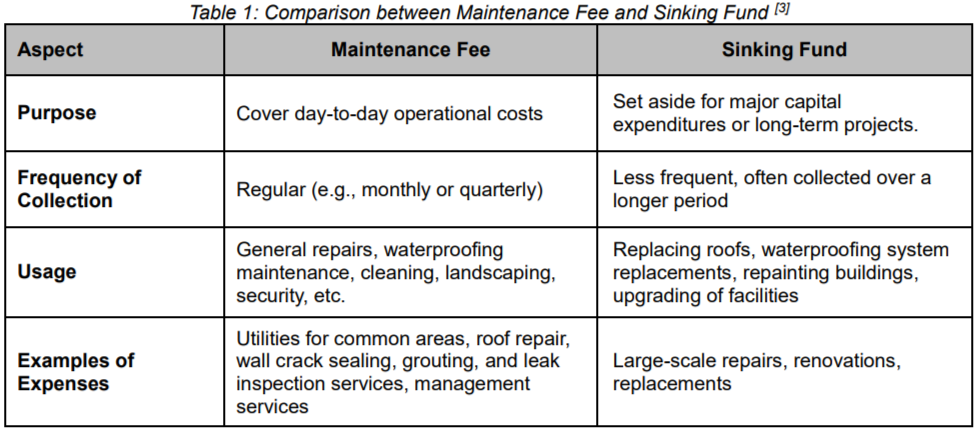
Differences between Maintenance Fee and Sinking Fund
Calculation of Maintenance Fee
The cost of maintenance fee depends on several factors, including:
- Type of Services: This generally includes items such as security services, cleaning services, and lift servicing.
- Type of Amenities: Amenities typically include features such as swimming pools, gyms, and event areas. More amenities offered will generally incur higher maintenance costs.
- Size and Type of Common Area: The larger the common area offered, the higher the cost incurred for cleaning and maintenance services. The cost also depends on the services required to maintain it. As an example, features such as intricate landscaping and water features may demand more maintenance compared to a regular community hall of the same size.
- Level of Service on Offer: Residents and property owners need to agree on what constitutes an acceptable level of services.
For calculation of maintenance fee, the formula is as follows:

How Much Sinking Fund Do You Have to Pay?
A sinking fund is determined at a rate of 10% of the maintenance fee. The Joint Management Body (JMB) or Management Corporation (MC) is allowed to modify this rate only during an annual general meeting (AGM). The JMB and MC must ensure that it remains at a minimum of 10% of the maintenance fee. Nonetheless, the JMB or MC does have the option to increase the sinking fund contribution beyond 10% of the maintenance fee. This adjustment requires unanimous approval from the members at the general meeting.
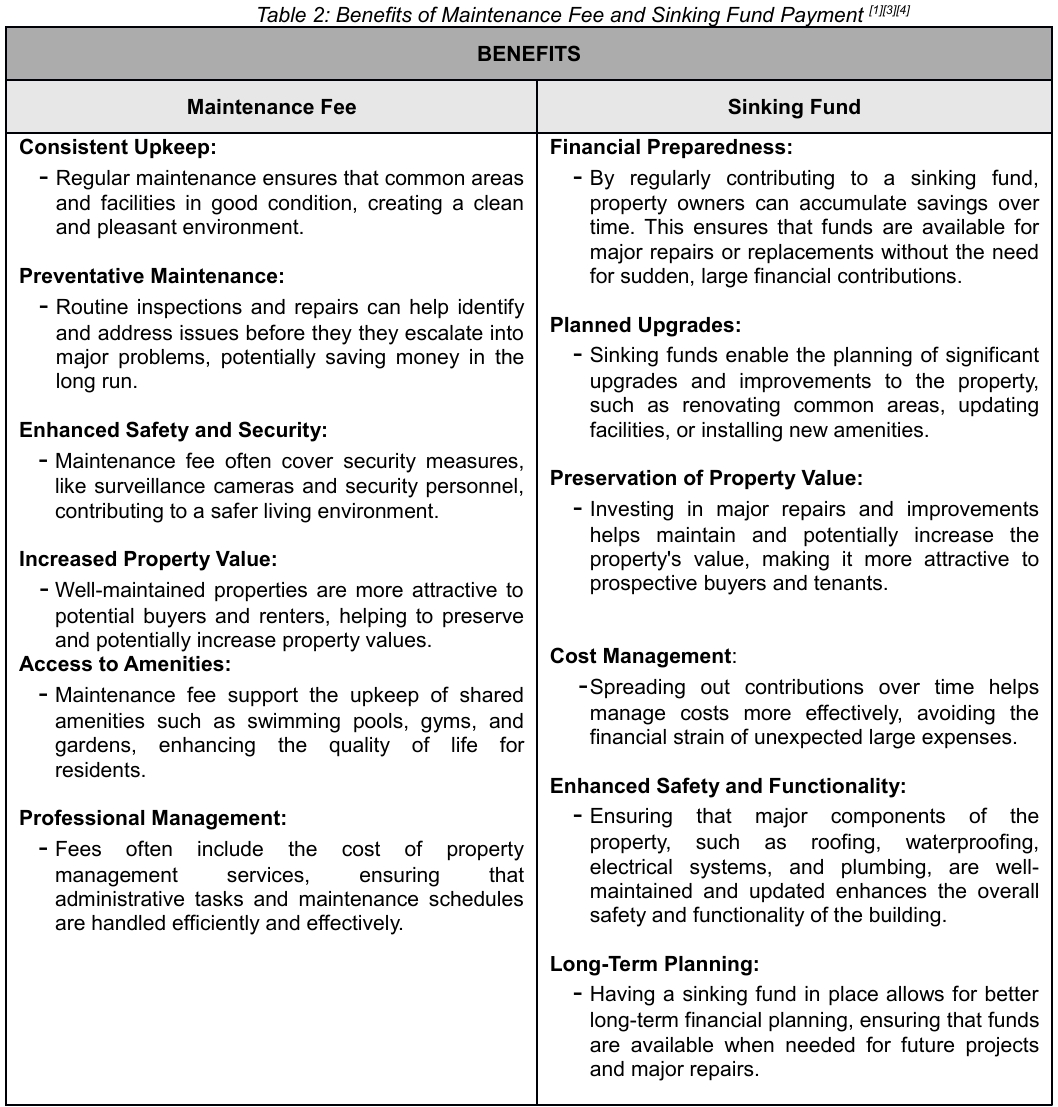
Benefits of Maintenance Fee and Sinking Fund Payment
What are the Potential Repercussions of Not Paying Your Building’s Maintenance Fee?
Failure to pay the maintenance fee can lead to legal repercussions, as the building management is legally entitled to take action against you. The process typically begins with the issuance of a demand notice for the outstanding maintenance fee. If the fees remain unpaid, the management corporation can take legal action in court to recover the amount owed [2].
Additionally, neglecting to pay these fees will result in the loss of your voting rights during the Management Corporation’s Annual General Meeting (AGM). It’s crucial to always settle your maintenance fee without delay to prevent the management from having the authority to enter your residence.